
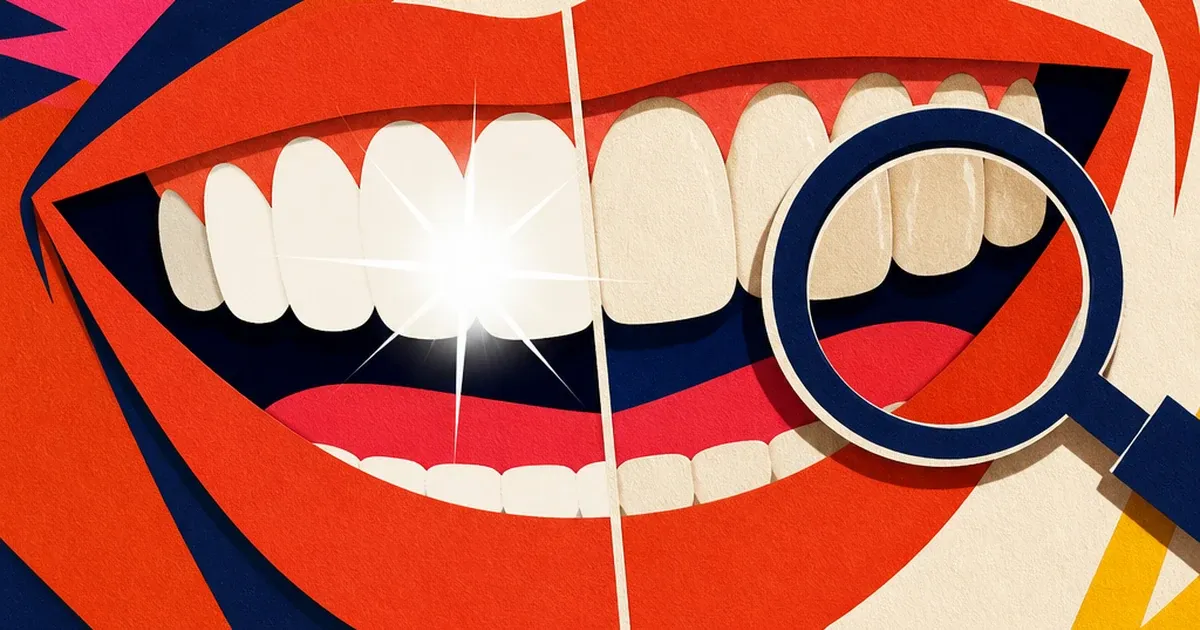
A ring flash is the standard light source for intraoral and close-up smile photography. It sits right around the lens, throws even light into a small, dark cavity, and lets a hygienist capture a sharp shot without a tripod. It is also, per the peer-reviewed dental-photography literature, a near-guaranteed source of specular highlights on wet enamel: small mirror-bright blowout spots that sit directly on top of the exact surface a whitening or veneer ad needs to show clearly.
Why the ring-flash glare spot is a marketing problem, not just a lighting nitpick
A 2023 literature review in Decisions in Dentistry on cross-polarized photography and shade matching lays out the mechanism plainly: direct ring-flash images "revealed different glare patterns caused by specular reflection from the tooth surface," while cross-polarized images were "glare-free... due to the complete removal of specular reflection," producing measurably better color-match accuracy in the CIELab coordinate system dentists use for shade communication (Decisions in Dentistry, 2023). One of the studies the review cites found a cross-polarizing filter produced meaningfully more standardized color reproduction than a plain ring flash or a smartphone camera on the same teeth (Decisions in Dentistry, 2023, citing Sampaio et al.).
That is a clinical-photography finding, but it is also a straight line to a marketing problem. A before-and-after whitening ad, a veneer case-study post, or a new-patient smile gallery all live or die on the viewer being able to actually see the tooth surface. A hot white blowout patch sitting across the middle incisors does the opposite of what the ad is trying to do: it hides the exact detail the practice is trying to sell, and it can make a genuinely good result look flat or fake in a small square Instagram crop, where the highlight eats even more of the visible tooth than it does in a full-size clinical photo.
Most practices are not shooting with a cross-polarizing rig in the first place. Cross-polarization requires filters on both the flash and the lens, careful setup, and consistent use across every patient photo, which is a workflow most solo and small-group practices never adopt outside of academic case documentation. The result is a marketing photo library shot the fast, ordinary way, with the glare intact.
The dental market has real money riding on this specific photo problem
The US dental office market is valued at $196.4 billion in 2026, growing at a modest 1.5% for the year (IBISWorld, 2026). Growth inside that market is not evenly spread: cosmetic and elective procedures are the fastest-moving segment, and every one of them is sold on a visual before-and-after, not a clinical chart. A practice that cannot show a clean, legible "after" photo is competing on a weaker asset than a practice next door with the same clinical result and a cleaner shot.
This is also a volume problem. A single practice's marketing calendar needs the same handful of patient photos reformatted for a Google Business Profile post, an Instagram square, a Meta Stories frame, and a new-patient landing page. A glare spot that is barely distracting at full desktop size becomes the dominant visual element once that same photo is cropped down to a 1080x1080 square or a 9:16 vertical frame, because the highlight does not scale down with the rest of the detail.
Fixing the glare without touching the shade
This is exactly the class of fix an AI photo-repair pass is good at: removing a bright, localized specular highlight from a small region of a photo while leaving the rest of the image untouched. On Coinis, that is enhance_asset_proxy, the same tool already demonstrated on a polished-metal specular hotspot in jewelry photography and on a blown-out fabric highlight in wedding dress photography. The mechanism is the same generic problem (a specular highlight blowing out the true surface detail underneath it), reapplied to a new vertical.
One hard condition before any of this goes near a real patient photo: an AI inpainting pass can remove a bright glare spot and restore plausible surface texture in that small masked region, but it cannot recover the actual tooth shade that the glare was hiding, because that pixel data is gone. The fix corrects a lighting artifact for cleaner, more legible marketing material. It is not a substitute for professional shade documentation, and it should never be presented as evidence of a clinical outcome. Every image in this workflow should stay clearly framed as a marketing asset: disclose that AI editing was used, keep the unedited original on file, and never caption a corrected photo as a "true shade" or treatment record. Practices should also check their own state dental board's advertising rules before publishing any before-and-after content, since those rules vary and sit outside what an ad platform can verify.
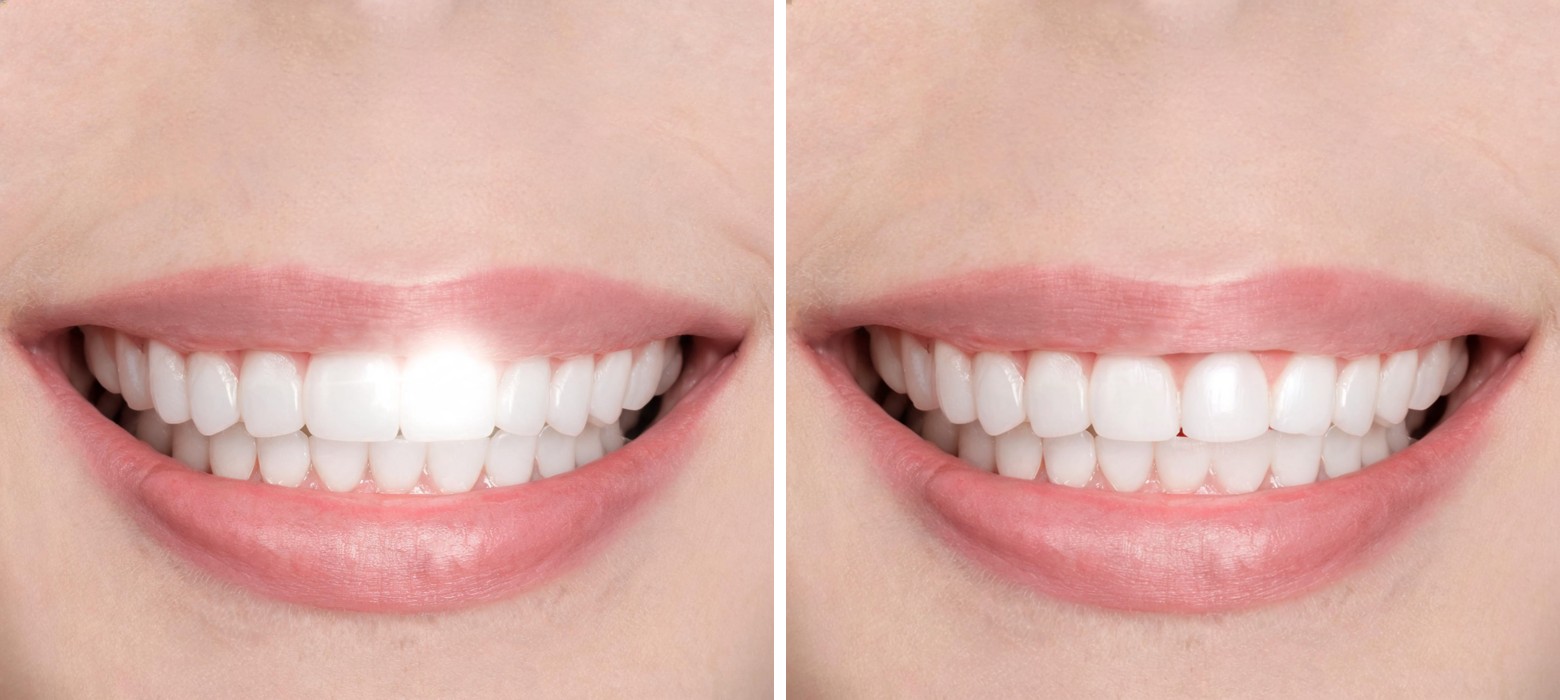
AI-generated example smile, not a real patient, per the health-adjacent-vertical condition above.
Once the fix is in, the same corrected photo needs to work across every format the practice actually posts to: a square Google Business Profile update, a 4:5 Instagram feed post, a 9:16 Story or Reel cover. That is what generate_image_templates does: one corrected source photo, fanned out into the ad sizes a practice actually needs, instead of re-shooting or re-editing per platform.
Building this into a repeatable workflow, not a one-off fix
A practice or a marketing team running dental ads does not need a photographer on every shoot day to get a clean library. The repeatable version of this workflow is: shoot with a ring flash like normal (fast, no special rig needed), run every marketing-bound smile photo through a glare-removal pass before it goes into any post, then fan it out to the ad sizes the practice actually runs. That turns an ordinary phone or DSLR photo into a set of clean, on-brand creative without a cross-polarization rig or a reshoot.
From there, the natural next step is Coinis Ad Studio: take the corrected photo and drop it into a template built for local-service or healthcare-adjacent advertisers, rather than manually resizing and captioning each format by hand. The pipeline is the same one already proven on jewelry, beauty, and skincare photography (see cosmetic photo color-cast fixes and skincare bottle translucency fixes), just reapplied to a dental practice's own most common photo problem. For a broader look at fixing ad photo defects generally, see the AI photo enhancer overview. Coinis also has a live dental industry page covering the platform's ad-creation tools for dental practices more broadly.
FAQ
Does an AI photo fix change what shade the tooth actually is? No. The fix removes a lighting artifact (the specular highlight from the flash) and restores plausible surface texture in that small region. It does not, and cannot, recover the exact underlying shade data the glare obscured. Never caption a corrected photo as a shade record.
Can I use this on real patient photos? Only with clear labeling that the marketing image has been edited, and only for lighting cleanup, never presented as treatment evidence. Check state dental board advertising rules first, since requirements vary and a photo-editing tool cannot verify compliance for you.
Why does a ring flash specifically cause this, more than other lighting setups? A ring flash sits directly around the lens axis, so its reflection off a wet, curved, glossy surface like enamel bounces straight back into the camera. Cross-polarizing filters correct this by blocking that direct reflection path, but most practices do not shoot with cross-polarization for everyday marketing photos.
Does this replace professional shade-matching photography for clinical use? No. Cross-polarized photography with proper calibration remains the more rigorous method for actual clinical shade communication. This workflow is for marketing photo cleanup, a separate use case with a lower bar and a much higher volume of images to process.
What ad sizes does the fan-out actually produce? Square (Google Business Profile, Instagram feed), 4:5 portrait, and 9:16 vertical (Stories/Reels cover), generated from the same corrected source photo via generate_image_templates.
The takeaway
The ring flash that makes dental photography fast and simple is the same light source that reliably blows out a specular highlight across exactly the tooth surface a whitening or veneer ad needs to show. The fix is not a re-shoot or a cross-polarizing rig, it is a targeted glare-removal pass on the photo already taken, followed by a format fan-out so one corrected photo covers every platform a practice actually posts to. Reduce the glare, keep the disclosure, skip the shade claims, and let the real result speak through a photo people can actually see.
Sources
- Sarkisians, Parichha, Sharma, Mong, Vaderhobli, "Utility of Cross-Polarized Photography in Dental Shade Matching," Decisions in Dentistry, June 9 2023: https://decisionsindentistry.com/article/utility-of-cross-polarized-photography-in-dental-shade-matching/
- IBISWorld, "Dental Offices in the US Market Size," 2026 ($196.4bn, 1.5% growth): https://www.ibisworld.com/united-states/market-size/dentists/1557/

Isidora Matovic
Author
Social media enthusiast and a full time researcher. She takes digital presence very seriously and that is why you are always in touch in what is going on with us! Follow us for more posts like this.