
A freshly groomed golden retriever sits for its after photo. Trimmed, fluffed, bandana on, ready for the salon's Instagram feed and its next ad. The photographer fires the on-camera flash and gets back a great shot of the haircut with one problem nobody planned for: two flat, glowing discs of green or yellow light where the dog's eyes should be, like a low-budget alien movie. Zoom in and the pupil detail, the thing that makes a "look how happy this dog is" photo actually land, is just gone.
It isn't a lighting mistake in the way a human photographer would think about lighting mistakes. It's a piece of dog and cat anatomy doing exactly what it evolved to do, colliding head-on with a flash mounted an inch from the lens.
Why a flash turns a pet's eyes into glowing discs
Most mammals that hunt or move around at night have a layer of tissue behind the retina called the tapetum lucidum, Latin for "bright tapestry." Wikipedia describes it plainly: it's an iridescent layer that reflects light back through the retina using the same interference principles as other iridescent tissue, which gives nocturnal animals a second pass at catching light their eyes already let in (en.wikipedia.org, 2026). Dogs and cats both have one. Humans don't, which is why a person's red-eye in a flash photo is a much weaker, differently colored effect than a dog's.
The same Wikipedia entry names the visible result directly: eyeshine, "a visible effect of the tapetum lucidum," which appears "when light shines into the eye of an animal having a tapetum lucidum" and makes "the pupil appear to glow" (en.wikipedia.org, 2026). A handheld flashlight in a dark yard is enough to trigger it. A camera flash fired an inch or two from the lens axis, exactly the setup on most on-camera and ring-light rigs a grooming salon uses for quick after-photos, is a far stronger, much closer light source pointed almost straight down the same optical path as the eye itself. The tapetum reflects that light straight back at the lens, and the sensor records it as a flat, saturated color disc instead of a normal pupil.
Why groomers and pet photographers run into this more than most
A human portrait photographer usually has room to bounce a flash off a ceiling, move a light off-axis, or just ask the subject to look slightly away from the lens. A groomer photographing a dog seconds after a haircut, in a small salon bay, on a tight schedule between appointments, rarely has any of that. The shot has to happen fast, indoors, often under whatever light is already mounted over the grooming table, and the dog isn't going to hold a pose for a three-light setup.
That combination, a fast on-axis flash and an animal eye built to bounce light back, is exactly the recipe eyeshine needs. It shows up in the same predictable spots every time:
- Before-and-after glamour shots, the single most important marketing asset a grooming business produces, and the one most likely to get shot fast with a single on-camera flash.
- Storefront and social feed photos taken in the low, warm ambient light typical of a grooming salon, where a flash is doing most of the actual illumination work.
- Any photo where the dog or cat looks toward the camera, which is most of them, since a pet looking away from the lens defeats the point of the shot.
None of this shows up as a technique failure the groomer could have avoided by holding the camera more carefully. It's a physics problem: light bounces straight back out of an eye that is built to bounce light around, and a flash mounted close to the lens is the worst possible angle for it.
The fix: correct the glow, keep the eyes
Coinis Ad Studio's photo-repair layer (enhance_asset_proxy) handles this kind of correction directly: restoring natural pupil and iris detail in a tightly masked eye region without touching the coat, the bandana, the background, or anything else in the frame. The goal isn't to erase the eyes or paint in a generic replacement, it's to bring back the natural dark pupil and iris color that the flash blew out, so the dog still looks like the same dog.
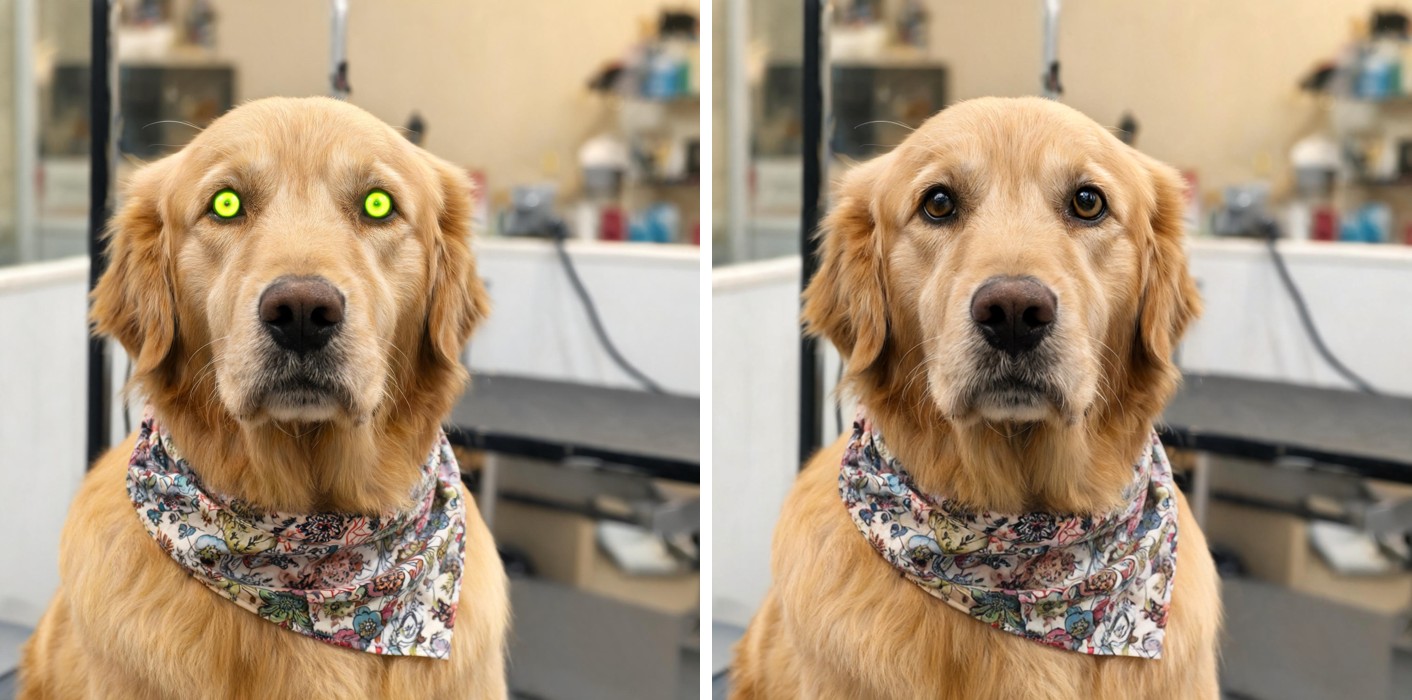
Once the eyes read naturally, the same photo needs to run everywhere a grooming business or pet brand actually advertises: a square feed post, a 9:16 Story for a before-and-after reveal, a landscape banner for a local-area retargeting campaign. Coinis's multi-format fan-out (generate_image_templates) takes that one corrected source image and produces it across every aspect ratio a campaign needs, so the fix happens once and the same clean photo pays out across the whole media plan.

Why this matters for the category specifically
Pet grooming is a genuine local-service category built almost entirely on visual proof, the same proof-driven dynamic behind electronics screen-reflection fixes and other product-photo repair work: a before-and-after photo is the actual product demonstration, not just supporting creative. A groomer or pet-care brand that never checks for eyeshine (the same product-photo discipline already covered for pet product photography and jewelry's own specular-glare problem) loses detail in exactly the part of the photo a potential customer looks at first, the animal's face and expression, the thing that signals "this is a happy, well-cared-for pet," not "this is a low-quality snapshot."
A glowing, blown-out eye doesn't read as a technical footnote. It reads as an unedited phone photo, which undercuts the premium, trustworthy positioning most grooming businesses and pet service brands are actually trying to sell to a customer deciding where to book next. Coinis also runs a dedicated pet industry page covering ad-creation tools built for this category.
What to do now
- Pull any pet photo shot with an on-camera flash or ring light and zoom into the eyes specifically, not just the overall composition or the groom itself.
- Look for a flat, saturated color disc replacing normal pupil and iris detail, the tell that separates eyeshine from a simple red-eye effect or a lighting exposure problem.
- Run the flawed photo through Coinis's photo-repair tool to restore natural eye detail without a reshoot, a different flash setup, or losing the fast, low-stress process a groomed pet actually needs.
- Fan the corrected photo out to every ad size your campaign needs from that single fixed source, then build the launch-ready ad in Ad Studio using a template built for the platform you're running.
FAQ
Is this the same thing as human red-eye in photos? No. Human red-eye comes from a much weaker reflection off the choroid, a different tissue layer that most people have. Dogs and cats have an additional reflective layer, the tapetum lucidum, built specifically to bounce light back through the retina for night vision, which is why the effect is stronger, more saturated, and a different color entirely (en.wikipedia.org, 2026).
Does moving the flash off the camera fix it during the shoot? Often, yes, for a future shoot. Moving the light source off the lens axis reduces how directly the tapetum reflects light back at the camera. But most grooming businesses are shooting fast, on-camera-flash after-photos between appointments, not running a studio lighting setup, so a photo-repair pass after the fact is usually the realistic fix for existing photos.
Does the fix change the dog's actual eye color or expression? No. The correction restores the natural pupil and iris detail that the flash blew out. It doesn't alter the animal's real coloring, expression, or anything else in the frame.
Do I need new photography for every platform, or just different crops? Once the eyeshine is corrected, most campaigns only need different crops and aspect ratios of that same corrected image, not new photography for every platform.
Turn the fix into every launch-ready ad
A corrected before-and-after photo is the input. The output that actually books appointments is a launch-ready ad built for the platform a grooming business or pet-care brand is running it on. Coinis Ad Studio takes the fixed photo straight into a template, so a glamour shot that was quietly losing its most important detail, the animal's own expression, becomes a finished ad ready to launch.
Sources
- Wikipedia, "Tapetum lucidum," https://en.wikipedia.org/wiki/Tapetum_lucidum (2026)

Isidora Matovic
Author
Social media enthusiast and a full time researcher. She takes digital presence very seriously and that is why you are always in touch in what is going on with us! Follow us for more posts like this.